

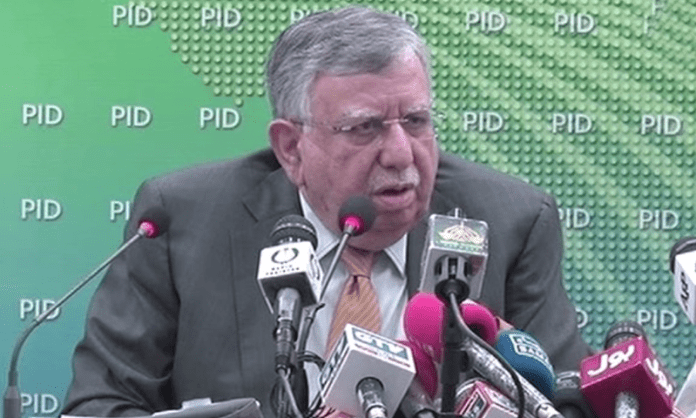
Finance minister also downplays controversy over the provisional economic growth rate of 3.94%
Finance Minister Shaukat Tarin said on Sunday that income tax rates for the salaried class will not be increased in the upcoming budget and vowed to bring legislation to put tax evaders behind bars.
While addressing a virtual press conference, the minister also downplayed the controversy over the provisional economic growth rate of 3.94%, saying that the growth was the result of prudent policies of Prime Minister Imran Khan. He hoped that in the next fiscal year 2021-22 the government can achieve 5% economic growth rate.
The government will end harassment by the Federal Board of Revenue (FBR) but people, who would not declare their incomes under the self-assessment scheme, will be put behind the bars, said Tarin.
The finance minister said that the tax rates for the salaried class will not be increased and the government will use “innovative methods” to enhance collection in the next fiscal year 2021-22.
The International Monetary Fund (IMF) has asked to set the Rs5.963 trillion tax target and the government will set the target close to it without taxing those who are already taxed, he added.
However, nearly Rs6 trillion target will remain unrealistic without additional revenue measures, as the target will be higher by Rs1.3 trillion or 27% over current year’s downward revised tax collection target. The nominal GDP growth will be just 12% and the rest of the gap cannot be bridged without additional taxation.
To a question about how the government will attain over 20% growth rate without levying more taxes equal to 1.2% of the GDP, the minister said that this will be done through innovative ways and bringing retail sector in the tax net.
The revenue collection has to be increased over 20% in the next fiscal year and until the FBR revenues are increased, the government will remain indebted and the budget deficit cannot be reduced, said Tarin. IMF, he added, wanted that the tax exemptions should be withdrawn.
“In line with IMF recommendations, we will seek to change the existing tax rate structure by reducing the number of rates and income tax brackets from eleven to five and decreasing the size of the income slabs,” according to the Memorandum of Economic and Financial Policies that former finance minister Hafeez Shaikh had sent to the IMF for revival of the programme.
The government will also try to get some leeway from the IMF on further extension in the real estate tax amnesty scheme beyond June but this is not a matter of make or break for Pakistan’s economy, said Tarin.
