

Report: Yahya Reki
The flood of 2022 took away the livelihood of the farmers due to which we lost lakhs of rupees and the local landlords are still suffering the consequences.
It has to be said that Haji Molabakhsh is a landlord by profession. Since the time of our ancestors, our source of livelihood is related to agriculture, but the last monsoon rains destroyed our crops.
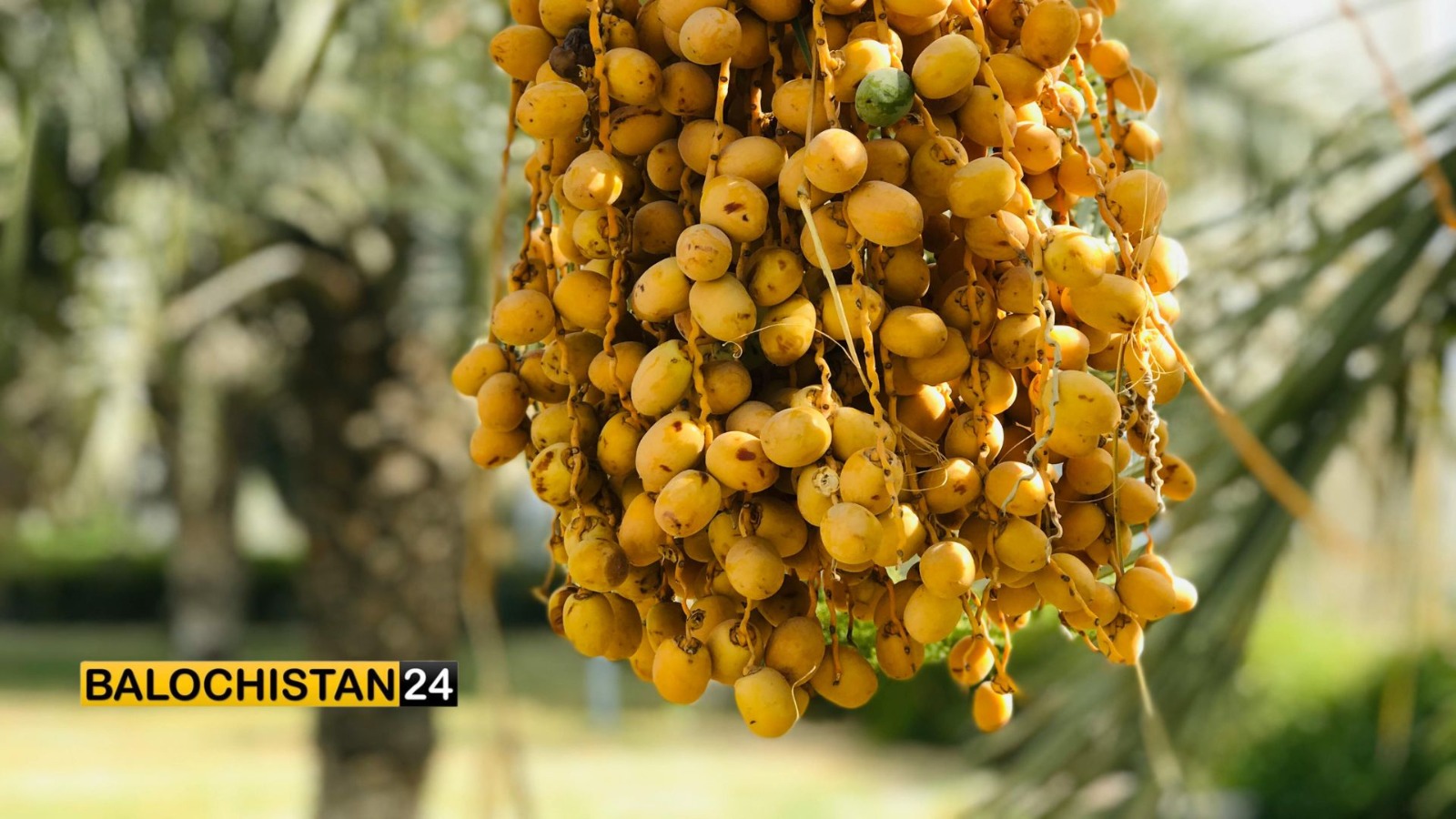
Palm plantations are found in other areas of Makran Division including Panjgur and Prom. Mozati, Jawan Sur, Begum Jangi and Sharifa dates are unique varieties.
There are more than 400 date plantations in Prome and the annual production of dates from here is 25000 tons. According to Haji Molabakhsh, an income of up to 40 lakh rupees can be obtained from a garden. There are 800 trees in his garden, of which 400 trees belong to Qasim’s palm trees.
Date palm plantations have been damaged due to climate change
In Ketch and Panjgur districts of Makran division, most of the farmers depend on date crop, but the monsoon rains have taken away this source of livelihood from them.
Haji Molabakhsh said that 90% of the date plantations were destroyed in the flood, due to which the farmers lost millions of rupees, 10 to 15% of the crops were left and even the basic expenses could not be met due to this.
In Balochistan, 75% of the people’s source of livelihood is related to agriculture and land sector, but due to recent climate changes, after untimely heavy rains, flood situation has arisen in many areas due to which farmers and laborers related to agriculture sector are facing financial difficulties.
According to the statistics of Agriculture department, there are 15 thousand 885 farmers registered in the district, who do farming in Balida, Turbat, Hoshab, Mandu and other areas. Farmers of Ketch district
Dependence is on the date crop, which is well known for its taste and high quality.
According to statistics, the annual production of dates in Kech is around 150,000 tons. Due to the monsoon rains last year, like other crops, date plantations have also been affected due to which the farmers have to face heavy financial losses.
The yield of date palm in Ketch is 6,590 kg per acre, which was lost to monsoon rains last year.
According to the sources of the Agriculture Department, there are 24,827 hectares of date plantations in Kech district, however, during the stormy rains in 2022, 18,885 hectares of date crops were destroyed due to floods. The estimated loss is 4 thousand 400 million.
According to the statistics of the Department of Agriculture, there are 105 types of dates in Kech district, which are unique in terms of taste and quality. These dates are cultivated in different areas.
According to statistics, the demand for “Begum Jangi” dates is high, which is the first and this type of dates is cultivated on 10,800 hectares and there are 18,57,600 trees in total, while the annual production of Begum Jangi is 65,16 tons and each tree produces an average of 35 kilograms of dates.
On the second place are “Husseini” date palms spread over 1,645 hectares, their annual production is 9,993 tons and the number of trees is 2,82,840.
Similarly, Halini 8 thousand 428 and Gok Nah (date varieties) are third and fourth with 7 thousand 775 tons respectively and the yield of these two types of dates is 40 kg per tree.
Date production in Pakistan
In the country, most of the date plantations are done in the two districts of Makran, Kech and Punjab. According to a report of 2005-2006, date plantations in Balochistan are 48,136 hectares and the annual production is 252,317 tons, in Sindh 26,681 and 192810 tonnes per annum, 5797 hectares in Punjab and 42580 tonnes in Punjab and 1377 hectares in Khyber Pakhtunkhwa and the annual production is 8869 tonnes.
Requirement of cold storage
The owner of a local date processing company and a well-known businessman, Muqbal Alam Noori, says that due to lack of cold storage, farmers in both districts sell dates at exorbitant prices.
In the past, a date processing cold storage facility was constructed in Kech, which has a capacity to store 1,000 tonnes of dates, while Makran Bhar produces 250 to 300,000 tonnes of dates annually. According to Maqbool Alam Noori, before this storage, the merchants of Sukkur and Khairpur used to buy between 800 and 900 per manna of dates from local farmers.
Now the local farmers are selling 2500 to 3000 dates per maund. He said that by building a date processing unit in Makran at the government and non-government level, not only Makran dates can be brought to global markets, but local landowners can get millions of rupees of extra profit every year.
According to them, Makran’s dates are more durable than neighboring Iran’s dates in terms of quality.
