

Report: Balochistan 24
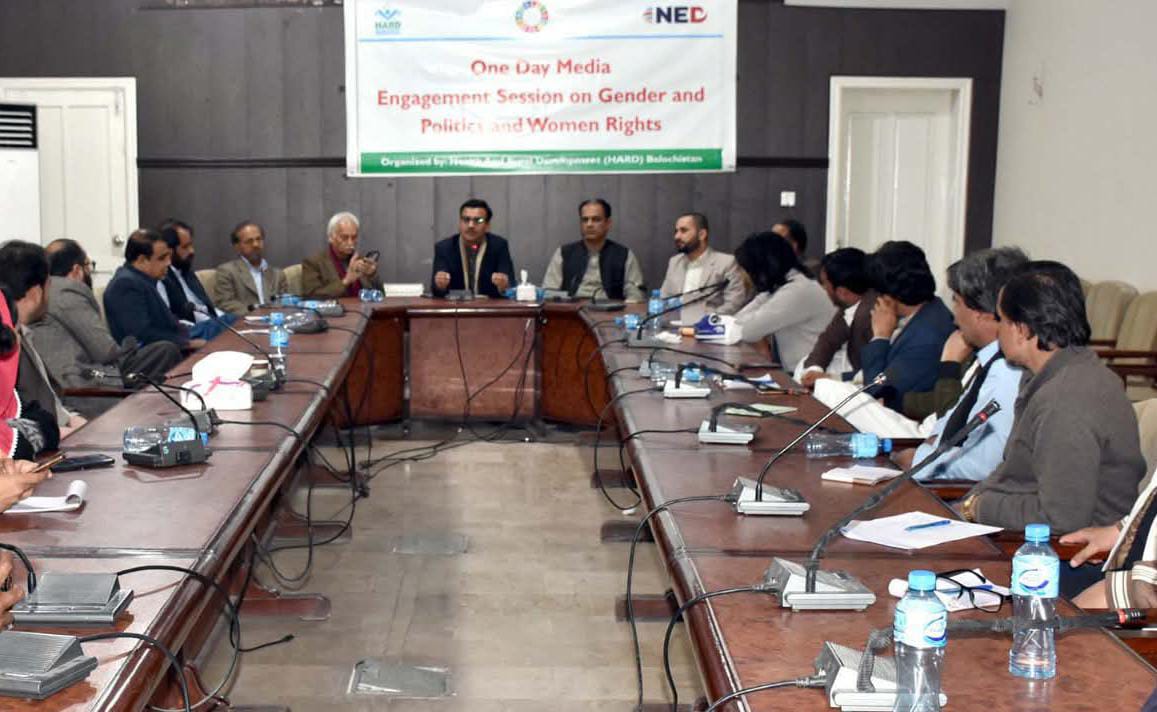
Quetta: The need for professional training of journalists in line with contemporary demands and stronger reporting on social issues was underscored at a media engagement session held in the provincial capital.
Speakers observed that quality and responsible journalism was not possible without equipping reporters with skills aligned with evolving digital trends.
The remarks were made by the president of the Balochistan Union of Journalists, Manzoor Ahmed Baloch, and other senior journalists while addressing a session titled “Media Engagement on Gender and Women Rights”, organised by Health and Rural Development (HARD) Balochistan. A large number of journalists from across the city attended the event.
Participants stressed that the media should prioritise coverage of women’s rights, strengthening of the local government system and pressing civic issues to help pave the way for resolving public problems. They noted that in the face of challenges such as censorship, responsible reporting on social matters had become even more crucial.
Head of Programme at HARD Balochistan, Zia Baloch, briefed participants on the organisation’s performance and objectives, highlighting provisions of the Local Government Act and subsequent amendments. He said women’s political representation in Balochistan had historically remained limited, largely confined to reserved seats, but had witnessed gradual improvement, with women now contesting direct elections at local, provincial and national levels.
Mr Baloch said journalism was a continuous learning process and emphasised that safeguarding livelihoods in the profession required journalists to adapt to digital media trends and emerging technologies, including artificial intelligence. He added that the union would continue its struggle for press freedom and against censorship.
Senior journalist Saleem Shahid highlighted the importance of investigative and fact-based reporting on civic issues such as water supply, sanitation, health, education and traffic management, saying these directly affected citizens’ daily lives.
Zafar Baloch underlined the significance of a strong local government system, stating that effective resolution of grassroots issues depended on empowered local bodies. He urged the media to highlight delays and administrative challenges related to local government elections in Quetta.
At the conclusion of the session, participants reaffirmed their commitment to promoting responsible journalism in Balochistan, particularly on women’s rights, local governance and broader social issues.
